Beverly Press
How Hollywood helped spread patriotism
By Randy Collins
July 4, 2026
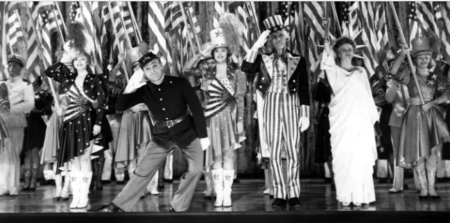
A little over 80 years ago, Hollywood legend James Cagney played song-and-dance man George M. Cohan in “Yankee Doodle Dandy.” The Oscar-winning role ended up having a lasting impact on culture, far beyond the movie. Released in 1942, right after the United States entered World War II, Cagney’s performance of unabashed patriotism communicated a feeling of hope during one of the nation’s most embattled times.
Cohan in real life was a consummate showman, whose best-known numbers included not only “The Yankee Doodle Boy,” but also “Over There” and “You’re a Grand Old Flag.” A statue of him sits in Times Square paying tribute to his contributions to the American theater. The movie subscribes to legend, moving Cohan’s birth from July 3 to July 4, and using the framing device of Cohan receiving the Congressional Gold Medal, presented by President Franklin D. Roosevelt. Sparklers, sequins and flags adorn musical numbers, lionizing the man as Hollywood’s vision of a patriot.
This is not to say that Cohan himself was not a patriot – by all accounts he was – but the way in which the Warner Bros.-produced, Michael Curtiz-directed film showcases it, in all its pizazz, splashes forward a template for which people still use to base their Independence Day festivities – all, of course, conveniently produced on sound stages and backlots actually located in Los Angeles County.
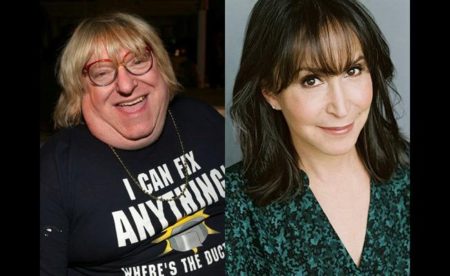
“People think they want to be in that world. They want to be in a world where, [it’s like] ‘Meet Me in St. Louis,’ that kind of thing, where Fourth of July is a big deal, and we’re all going to go out and shoot fireworks,” writer, comedian, actor and Hollywood aficionado Bruce Vilanch said. “Who knows if George M. Cohan was really a patriot or was he just a showman? That was a way of getting the audience on his side.”
It is during those World War II years Hollywood went full tilt into projecting that stars and stripes on screen. Los Angeles, the true motion picture company town, fully embraced the war effort, as well. In addition to hundreds of recognizable actors enlisting in the armed services – including James Stewart, Henry Fonda and Clark Gable – those on the homefront sold war bonds, performed in the newly-established United Service Organizations and helped run the Hollywood Canteen, the studio-run club created for service members to meet and interact with the stars.
“The studios all were involved in the war effort, and I think they were a big part of keeping not only the morale up on the home front but also encouraging people to enlist in the war effort,” said Bryan Cooper, the producer of the Cinecon Classic Film Festival.
Cooper noted that studios greatly increased their production output during the war years, and the films produced almost all had some tinge of patriotic propaganda attached to them – including title cards at the end encouraging patrons to buy war bonds. Movies promoting the freedoms and might of America helped to rally those both at home and abroad. “Casablanca” artfully showcased an ex-pat who finds his patriotism. “Mrs. Miniver,” though set in England, shined a light on the self-sacrifices of a middle-class family, a theme that would be echoed in the U.S.A.-set “Since You Went Away.” “Destination Tokyo” and “Air Force,” among many, many others, glorified the bravery of soldiers.
“The films are behind that, and the stars were also enlisted to promote that kind of patriotism, devotion, that love for our country. So that they got you on a gut emotional level … so that you were going to just give whatever you could of yourself or your time or your finances in order to get the outcome that we eventually got, but we didn’t know at that time if we would win,” Cooper said.
This kind of sentiment piggy-backed on the movies of Frank Capra from the late 1930s and early 1940s, which highlighted hokum community spirit of the American small town – real or imagined. “You Can’t Take It With You” and “Meet John Doe” leaned heavily into these ideals, and “Mr. Smith Goes to Washington” almost certainly had the most lasting impact, with its small-town-hero-conquers-D.C.-corruption storyline.
“Frank Capra really did feed into patriotism, idealism, love of our country and the good within people being brought out and human qualities. He was a master at sort of touching on those chords and brain chemistry, and I think really changing the hearts and minds of a lot of people through he way he told his stories,” Cooper said.
During the Great Depression, as Americans struggled economically, Hollywood made movie after movie that established quintessential small towns, ala the “Andy Hardy” series that starred Mickey Rooney, as well as other musical films that featured Rooney and the young powerhouse Judy Garland.
“People were always very depressed that their lives were not like people in MGM movies,” Vilanch said. “Their families were not like Andy Hardy’s families.”
This Americanism was very whitewashed, morally strict and Chistian-adjacent, even if not overtly stated as being so. This was what the moguls felt the U.S.’s core audience wanted to see and aspire to, and it was also what would most certainly not ruffle the ire of censors or politicians who wanted to hold up the movies as something akin to sin. But the true irony sat in who was running the movie studios. Most of the studios’ heads, including Louis B. Mayer and Jack Warner, were Jewish immigrants.
“They were barred from being in any of the major institutions that traditionally [were not open to] the Jews – I being one – and so they kind of took over show business and used it to create an idealized view of America that they wanted to be a part of,” Vilanch said. “This was all an idealizing that they made up, and that they tried to live. So, obviously they influenced things very heavily. And our perception of America – and the flag waving and red, white and blue and all that kind of stuff – they just kept firing with that kind of stuff over the years. They were part of the pageant.”
By the end of World War II, a quietly patriotic, but subtly antiwar film like “The Best Years of Lives” seemed rather bold.
“The post-war period … I think is more important,” Vilanch said, adding that he felt the country is still feeling the ripple effects over 80 years later. “We’re still in it, it seems, [more so] than some kind of cocked-up celebration with people, fireworks and a lot of patriotism that disappears on July 5.”
Somewhere between post-war pessimism, pre-war musical numbers baked in monochromatic red, white and blue, James Stewart’s epic filibuster and Mickey Rooney’s “aw shucks” spunk, an idea of patriotism was born. In these commercial products, America saw its identity flashed in light and shadow, and those fireworks and flags remain the basis for how the Fourth of July holiday is celebrated to this day – all ideas either born or emboldened by immigrants subscribing to the American Dream.